







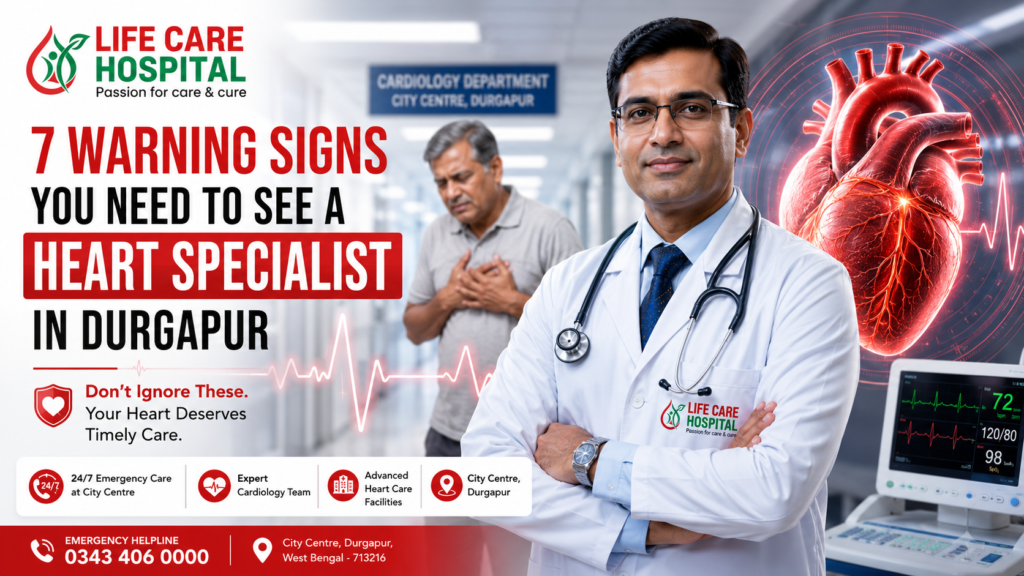
7 Warning Signs You Need to See a Heart Specialist in Durgapur — Don’t Ignore These
7 Warning Signs You Need to See a Heart Specialist in Durgapur — Don’t Ignore These
Heart disease is the leading cause of death in India — and Durgapur’s rapidly growing urban population, industrial workers, and stressful lifestyle are putting more and more people at risk every year. The dangerous truth is that most heart problems begin silently. By the time many patients reach a heart specialist in Durgapur, the condition has already progressed.
The good news? Your body always gives warning signs. You just have to know what to look for.
At LifeCare Hospital Durgapur, our cardiology team — available 24/7 at City Centre — sees patients every week who waited too long before seeking help. This article will show you the 7 critical warning signs that mean you need to book an appointment with a cardiac specialist — without delay.
Is Heart Disease Really a Risk in Durgapur?
Yes — more than most people realise. Durgapur is home to a large population of industrial workers, salaried professionals, and businesspeople — all of whom face risk factors that quietly damage the heart over years. These include high blood pressure, Type 2 diabetes, smoking and tobacco use, sedentary desk jobs, poor diet high in refined carbs and trans fats, and high stress.
According to cardiologists across West Bengal, cardiac events are increasingly being seen in people aged 35–50 — not just in the elderly. This makes it essential for every adult in Durgapur to understand the warning signs and know when to see a heart specialist in Durgapur before a minor issue becomes a medical emergency.
7 Warning Signs You Should Never Ignore
Here is a quick overview before we go deeper into each sign:
| # | Warning Sign | Why It Matters |
|---|---|---|
| 1 | Chest pain or pressure | Pressure, squeezing, or burning in the chest — especially during activity — can signal blocked arteries. Never ignore this. |
| 2 | Shortness of breath | Feeling breathless after mild activity or even at rest may indicate the heart is not pumping blood efficiently. |
| 3 | Rapid or irregular heartbeat | Palpitations, fluttering, or sudden racing heart — especially with dizziness — can point to arrhythmia (irregular rhythm). |
| 4 | Unexplained fatigue | Persistent tiredness that does not improve with rest, especially in women, is a common but under-recognised heart warning sign. |
| 5 | Dizziness or fainting | Sudden lightheadedness or fainting episodes may indicate a drop in blood pressure caused by a heart rhythm problem. |
| 6 | Swollen legs or ankles | Fluid accumulation in the lower body can be a sign of heart failure, where the heart struggles to circulate blood properly. |
| 7 | Strong family history | If a parent or sibling had a heart attack before age 55 (men) or 65 (women), you are at higher risk — regular screening is essential. |
1. Chest Pain or Tightness — The Most Urgent Sign
Chest pain is the single most important symptom to never dismiss. It may feel like pressure, squeezing, heaviness, or burning in the center or left side of the chest. It often spreads to the jaw, left arm, or back.
This could indicate angina (reduced blood flow to the heart muscle) or — in severe cases — a heart attack. If chest pain occurs during physical activity and eases with rest, see a heart specialist in Durgapur the same day. If it does not ease, call our emergency helpline immediately.
2. Shortness of Breath at Rest or With Mild Activity
Feeling breathless after climbing one flight of stairs, or even while lying down, is not normal — and is not simply a fitness issue. When the heart is unable to pump blood efficiently, fluid can build up in the lungs, causing breathlessness.
This is a classic symptom of heart failure and should prompt an immediate visit to a heart specialist in Durgapur. An echocardiogram and ECG can assess your heart function within hours at LifeCare Hospital.
3. Rapid, Irregular, or Fluttering Heartbeat (Palpitations)
Do you ever feel your heart racing suddenly for no reason, skipping beats, or fluttering in your chest? These are called palpitations, and while they can be harmless, they can also signal atrial fibrillation (AFib) — a serious rhythm disorder that significantly increases stroke risk if left untreated.
If palpitations occur frequently, last for more than a few minutes, or are accompanied by dizziness or chest discomfort, a cardiac specialist needs to evaluate you with a Holter monitor or ECG at the earliest.
4. Chronic, Unexplained Fatigue
This is one of the most overlooked heart warning signs — especially in women. If you feel persistently exhausted even after a full night’s sleep, struggle to complete daily tasks that were once easy, or feel drained without any clear cause, your heart may be struggling to supply enough oxygenated blood to your body.
In Durgapur’s industrial workforce, this symptom is frequently blamed on work stress or poor sleep — and a cardiac cause is missed. At LifeCare Hospital, our cardiologists specifically look for this “silent” symptom during routine consultations.
5. Dizziness, Lightheadedness, or Fainting Episodes
Sudden dizziness or fainting can result from a temporary drop in blood pressure caused by an abnormal heart rhythm. This can be a sign of a serious arrhythmia and warrants immediate medical evaluation by a heart specialist in Durgapur.
Do not assume these episodes are caused by heat, dehydration, or low blood sugar without ruling out a cardiac cause first — especially if they occur more than once.
6. Swelling in Your Legs, Ankles, or Feet
Unexplained swelling (edema) in the lower limbs — where your socks leave deep marks on your skin — is a common but often ignored sign of heart failure. When the heart does not pump effectively, blood backs up in the veins, and fluid leaks into surrounding tissues.
If you notice increasing swelling that worsens by evening, or if you find your shoes feeling tight at the end of the day, consult a heart specialist in Durgapur promptly. Combined with breathlessness, this symptom is a red flag that needs same-day attention.
7. Strong Family History of Heart Disease
This is not a symptom you feel — but it is one of the most powerful risk factors for developing heart disease. If a parent, sibling, or close relative had a heart attack, bypass surgery, or heart failure before the age of 55 (men) or 65 (women), your risk is significantly elevated.
Even if you feel perfectly healthy, a proactive heart checkup in Durgapur — including a lipid profile, ECG, echocardiogram, and blood pressure assessment — is strongly recommended once you cross the age of 30 in such cases. Prevention is always better than emergency treatment.
Don’t wait for a heart emergency. Contact us.
LifeCare Hospital Durgapur | Expert Cardiologist Available
City Centre, Durgapur | Emergency: 7477716138 | Available 24/7
Book Appointment: lifecarehospitaldurgapur.in/appointment
What Happens at a Cardiology Consultation at LifeCare Hospital?
Many patients in Durgapur delay seeing a cardiologist in Durgapur because they are unsure what to expect. Here is what a typical first consultation at LifeCare Hospital looks like:
Detailed history-taking: Your doctor will ask about symptoms, lifestyle, family history, and existing conditions
ECG (Electrocardiogram): A quick, painless test that checks your heart’s electrical activity
Blood pressure and pulse assessmentEchocardiogram if required: An ultrasound of the heart to check structure and function
Lipid profile and blood sugar tests to assess cardiovascular risk
Personalised treatment plan: Medication, lifestyle advice, or referral for further investigation
The entire process is transparent, affordable, and completed under one roof at LifeCare Hospital, City Centre. Our patients from Benachity, Bidhannagar, Nachan Road, Asansol, and Andal regularly choose us for the convenience and quality of our cardiac care.
5 Daily Habits That Protect Your Heart — Recommended by Our Doctors
Walk 30 minutes daily — even a brisk evening walk significantly reduces cardiac risk
Reduce salt, refined sugar, and fried foods — Durgapur’s diet is often high in all three
Manage your blood pressure — check it at least once a month if you are above 35
Quit tobacco in all forms — smoking and chewing tobacco are direct risk factors for heart attackSleep 7–8 hours — poor
sleep elevates cortisol, which raises blood pressure and heart rate